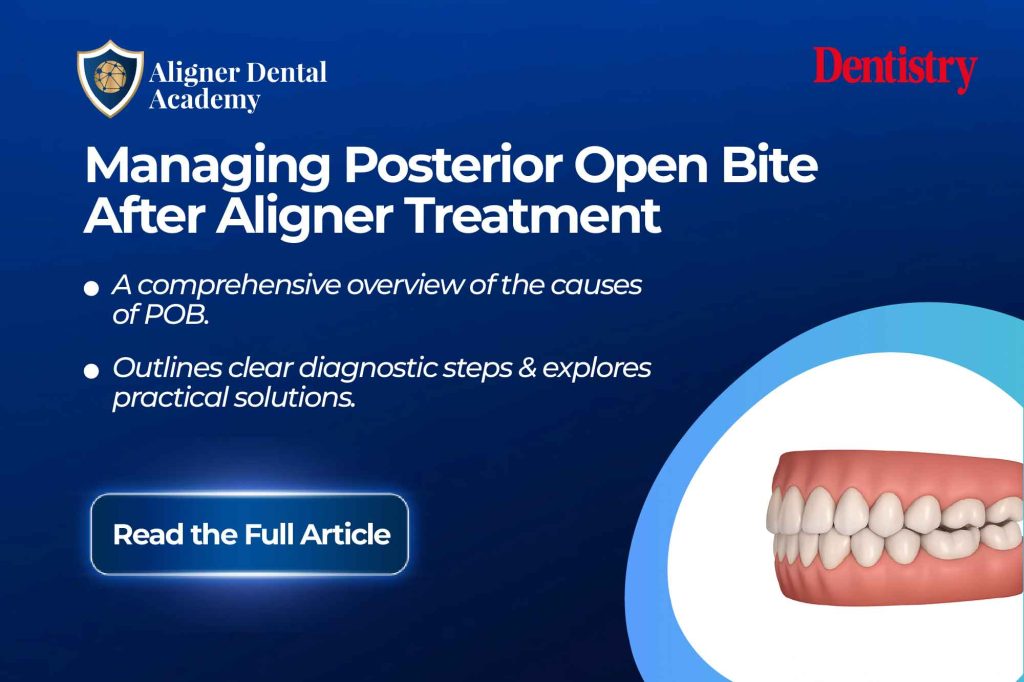
The Aligner Dental Academy presents a guide to managing posterior open bite malocclusion during or after clear aligner treatment.
What is a posterior open bite?
Posterior open bite (POB) is a type of malocclusion in which the posterior teeth, the premolars and molars, fail to make occlusal contact while the anterior teeth do. This results in a visible gap between the opposing posterior teeth when the patient bites down. If left unaddressed, a POB can impair chewing efficiency and compromise long-term occlusal stability.
It is not uncommon for a posterior open bite to be observed during or after clear aligner treatment. Patients can report this as discomfort or heaviness in the front teeth, and that the back teeth do not occlude as expected. Recognising, diagnosing, and managing a POB is essential to achieving optimal occlusion and patient satisfaction.
Common causes of posterior open bite after aligner treatment
- Lack of posterior occlusal contact: aligner trays cover the occlusal surfaces and can function as bite blocks. This may inhibit vertical settling, leading to POB
- Premature contact of anterior teeth: premature contact of anterior teeth can lead to POB. This is often seen in class III cases, cases with reduced overjet, or deep bite corrections where anterior intrusion is incomplete
- Unwanted buccal crown tip during expansion: in some cases, unwanted buccal crown tipping, rather than translation, occurs during arch expansion. This can result in buccal flaring, causing a lack of posterior occlusion
- Incomplete molar extrusion: in cases where molar extrusion was planned, such as deep bite correction, failure to achieve the full extent of the movement can prevent the posterior teeth from coming into contact
- Overuse or improper use of inter-arch elastics: improper or prolonged use of inter-arch elastics can intrude posterior teeth, especially if vertical control isn’t addressed
- Tongue posture or habits: lateral tongue thrust or habits during or after treatment can impede posterior contact and prevent the development of a stable bite.
Diagnosing posterior open bite
Effective diagnosis involves a combination of clinical observation and patient feedback:
- Perform visual and tactile examination of the occlusion
- Listen to patient-reported symptoms, such as the sensation of only the front teeth contacting
- Use articulating paper to analyse contact distribution
- Stabilise the anterior teeth with light pressure during bite closure to detect any posterior separation
- ClinCheck or digital treatment plans can also help identify cases at risk of POB, allowing for pre-emptive planning.
Treatment options for posterior open bite
There are several effective approaches depending on the severity and cause of POB:
1. Dahl appliance (for ≤1mm POB)
This simple, effective method uses the last lower aligner, trimmed distal to the canines. Attachments on canines help prevent dislodgement. The patient wears it 22+ hours per day, while continuing to wear the last upper aligner at night for retention. Posterior contact usually returns within one to two months.
2. Box or triangular elastics (for >1–2mm POB or individual teeth)
Plan button cutouts on the aligner and apply buttons directly on the teeth. Ensure plenty of posterior attachments for retention. Box elastics can be used in conjunction with the Dahl appliance technique to enhance the effectiveness of POB correction.
- Use medium force (3.5oz, 1/8” or 3/16”)
- Metalor tooth-coloured buttons can be placed using bracket cement and standard bonding techniques
- Instruct patients to wear elastics 18+ hours per day and change them daily.
3. Additional aligners with posterior extrusion movements
For generalised POBs, program extrusion of all posterior teeth in additional aligners. Include box elastics and incorporate attachments on molars for improved anchorage.
4. Relieve premature anterior contacts
Evaluate for premature anterior contacts hindering posterior occlusion. Perform selective incisal adjustments in additional aligners to achieve proper clearance.
5. Additive equilibration (rare cases)
Apply composite build-ups on the occlusal surfaces of posterior teeth to create balanced contacts when extrusion or re-alignment is not feasible.
How to prevent posterior open bite
- Use digital tools such as ClinCheck to identify and prevent POB in high-risk cases (eg deep bite, Class III, reduced overjet, etc)
- Plan sufficient interincisal clearance and overjet to prevent premature anterior contacts
- Monitor posterior contact throughout treatment to track POB development, enabling early detection and correction
- Inform the patient early if occlusal refinement may be needed post-treatment
- Program settling protocols, vertical elastics and posterior extrusion when needed.
Conclusion
Posterior open bite after aligner treatment is a relatively common and manageable issue. By understanding its causes, clinicians can better identify patients at risk and implement strategies to correct or prevent it, ensuring patients complete treatment with both a functional and aesthetic result.
For more information, visit www.alignerdentalacademy.com.
This article is sponsored by Aligner Dental Academy.