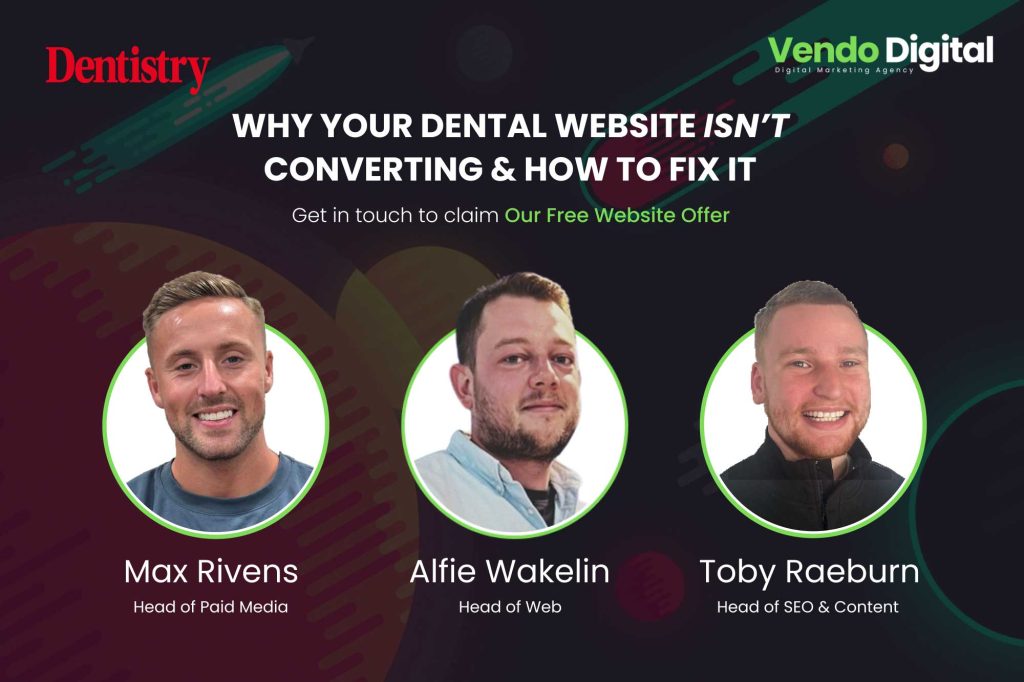
Vendo Digital shares five key reasons why your dental business website isn’t getting results and how to overcome these barriers.
Your dental website might look clean, modern and professional – but if it isn’t turning visitors into patients, it’s not doing its job.
In an increasingly competitive landscape, where private dentistry is growing and patient expectations are rising, a high-performing website is no longer just ‘nice to have’ – it’s a central part of your marketing engine.
Vendo Digital works with dental practices across the UK to improve their visibility, streamline their digital patient journeys, and generate new enquiries. One of the most common challenges? Websites that don’t convert.
Let’s explore the five most common reasons why, and what you can do to fix them.
1. Poor mobile experience
More than 70% of dental website traffic now comes from mobile devices. If your site isn’t optimised for smaller screens – with clickable buttons, legible text, and a seamless booking experience – users will bounce before they even consider calling.
How to fix it:
- Use a mobile-first design approach
- Test across multiple devices (not just your iPhone)
- Avoid pop-ups that block the screen or forms that are hard to fill in
- Make sure the phone number is ‘tap-to-call’.
2. Slow page load speed
A delay of just one second in load time can drop your conversion rate by up to 7%, and it’s even more critical on mobile. Patients aren’t going to wait for your homepage slider or embedded video to buffer.
How to fix it:
- Run your site through Google PageSpeed Insights
- Compress large images and remove unnecessary plugins
- Host videos externally (eg YouTube or Vimeo) rather than embedding high-res files directly.
3. Confusing or overcomplicated navigation
Patients aren’t SEO experts. If they can’t find what they need in under 10 seconds – whether it’s Invisalign, dental implants, or emergency appointments – they’ll move on to a competitor’s site.
How to fix it:
- Create a clear, focused navigation bar with key services
- Add dropdown menus for treatments, team, finance options, etc
- Use breadcrumb links and internal linking to guide users
- Include a prominent ‘Book now’ or ‘Free consultation’ button in your header.
4. Weak or non-existent calls to action
If you don’t ask the user to take action, they probably won’t. Many dental websites simply list services without nudging patients to get in touch.
How to fix it:
- Add strong calls to action (CTAs) throughout the site: ‘Book your free smile consultation’, ‘Speak to our Invisalign team today’, ‘Call now to check availability’
- Place CTAs above the fold on key pages
- Use contrasting colours so they stand out visually
- Link buttons directly to your contact form or booking platform.
5. Lack of trust-building elements
Patients are choosing someone to look after their smile, health, and appearance – trust is non-negotiable. Yet many dental sites lack simple reassurance features that can boost credibility instantly.
How to fix it:
- Showcase real patient reviews (Google or Trustpilot embeds)
- Use photos of your actual team, not stock imagery
- Add affiliations (eg GDC, BDA, Invisalign provider badges)
- Include a video walk-through or clinician introduction to humanise your practice.
How your website impacts the whole patient journey
Your website isn’t just a brochure — it’s the conversion point for everything else you do in marketing.
If you’re investing in Google Ads or paid social, but patients land on a slow, confusing or unconvincing website, that spend is being wasted. Your quality score in Google Ads depends partly on landing page experience. Your conversion rate is directly tied to website usability. And your brand perception can be made or broken in those first few seconds of a click.
A good dental website doesn’t just attract patients. It reassures them, educates them, and makes it easy to take the next step.
What does a high-converting dental website look like?
Vendo Digital specialises in building and optimising websites specifically for dentists – blending best-in-class design with digital strategy whether you’re an established practice or a squat practice ambitious for profitable growth.
Here’s what Vando believes every effective dental site should include:
- Fast load speed across devices
- Mobile-first design with clear navigation
- Compelling, benefit-led copy that answers: ‘What’s in it for me?’
- Trust elements like reviews, accreditations, and clinician bios
- Calls to action that appear on every scroll
- Landing pages tailored for high-converting services (eg Invisalign, implants)
- Conversion tracking to measure performance and optimise campaigns
Ready to fix your website?
If your current site isn’t delivering results – or if you’re planning to invest more in digital marketing – it’s worth reviewing your website first.
Vendo Digital offers free website audits for dental practices across the UK. Vendo will review your mobile experience, speed, user journey, and conversions, then show you where improvements can be made.
Visit www.vendodigital.co.uk or get in touch to book a free consultation.
This article is sponsored by Vendo Digital.