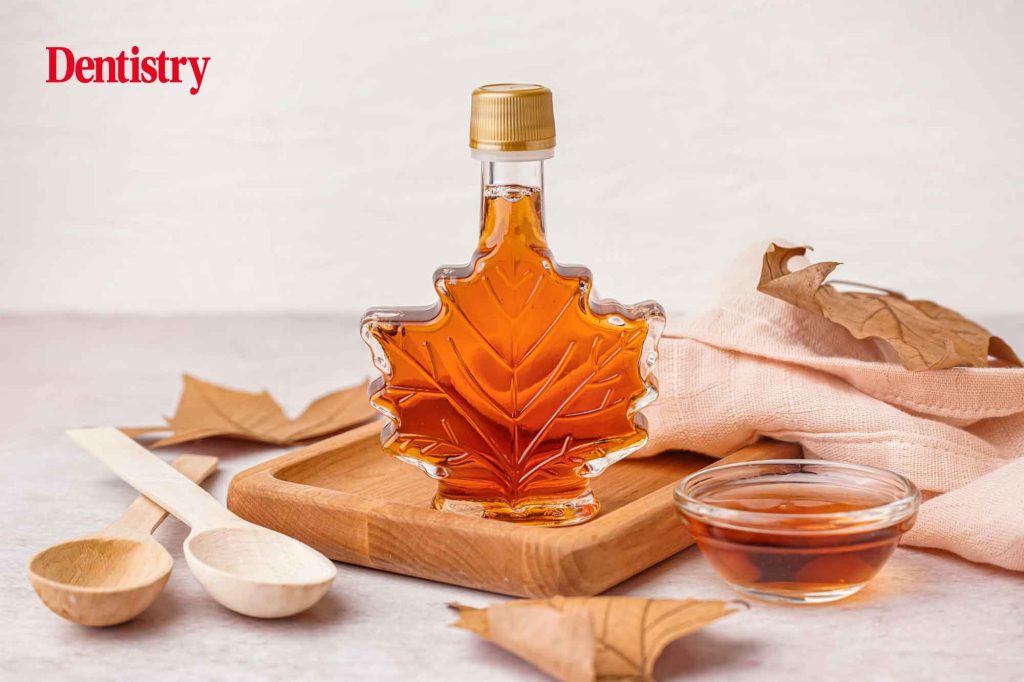
A compound derived from maple trees and naturally occurring in maple syrup was found to prevent caries-causing biofilm from adhering to teeth in a new study.
The compound, epicatechin gallate, has been described as ‘a powerful and safe alternative to traditional plaque-fighting agents’.
Researchers unexpectedly observed that bacteria formed a biofilm on some plants but not others, including maple. This led them to investigate it’s anti-bacterial properties further.
The team isolated the epicatechin gallate compound and tested it against bacteria such as Listeria and Streptococcus. They found that it inhibited the bacteria’s ability to adhere to surfaces, preventing biofilm formation.
The maple compound’s efficacy against Streptococcus mutans stood out, as this is the bacteria which causes dental caries.
Maple is a ‘safer alternative’
Mark Gomelsky is director of the microbiology program at the University of Wyoming and a corresponding author of the study. He said: ‘Since Streptococcus mutans initiates cavities by forming biofilms (plaques) on teeth and producing acid that destroys tooth enamel, we asked: could maple polyphenols also inhibit S mutans biofilms? That question drove this study.’
The first experiments were conducted through computer modelling, then in a test tube. The findings were then tested on plastic teeth and hydroxyapatite disks as a stand-in for real tooth enamel. In all cases, the maple compound prevented biofilm formation.
‘In a way, this study felt almost too easy,’ Professor Gomelsky said. ‘Everything fell into place just as we predicted. That’s a rare experience in science, and probably the first time it’s happened in my 35-year research career.’
The researchers said that the maple compound could potentially be added to dental products to prevent tooth decay through an anti-biofilm mechanism.
Gomelsky added: ‘This is different from traditional approaches, which rely on killing bacteria with alcohol, disinfectants or essential oils, or on fluoride to remineralise enamel. The anti-biofilm approach using edible polyphenols is especially appealing for young children.
‘For example, young children can’t use conventional mouthwashes because they might swallow them and risk toxicity. A safer alternative, such as a mouthwash containing an effective dose of an edible polyphenol, could provide protection without harmful side effects.’
Do other foods have anti-biofilm effects?
Epicatechin gallate is also found in green and black tea. Green tea has been firmly linked to lower levels of cavities, though the epigallocatechin gallate compound rather epicatechin gallate has been previously extracted from it for use in dental products. This study suggests that epicatechin gallate may actually be the more powerful compound against biofilm formation.
In January, a study found that green tea was also effective against oral inflammation. Containing anti-oxidants called catechins, green tea has previously been found to have anti-inflammatory properties. Building on this, researchers at the Tokyo University of Science (TUS) explored the potential for using these catechins to treat oral mucositis.
The condition causes painful inflammation in the mouth which can affect patients’ ability to eat and sleep.
Takehisa Hanawa, research team leader, said: ‘Our goal was to create a formulation for oral mucositis that patients could use easily and comfortably, helping to prevent the decline in quality of life and difficulties with eating caused by cancer treatments.’
Follow Dentistry.co.uk on Instagram to keep up with all the latest dental news and trends.