Victoria Sampson explores the benefits of guided enamel regeneration, a non-invasive peptide treatment for early caries.
Many people are familiar with professional remineralising agents, such as fluoride varnish, but far fewer have heard of self-assembling peptides. What makes CURODONT REPAIR a game-changer for early caries?
CURODONT REPAIR is definitely a game-changer in dentistry. For decades, we have only had products at our disposal that are able to remineralise the surface layer of the enamel and are unable to penetrate deeper within, like fluoride varnish.
CURODONT REPAIR introduces a biomimetic approach to dentistry that uses self assembling peptides to diffuse into the depth of the caries lesion and regenerate hydroxyapatite crystals (enamel) from the depth of the lesion body upwards. This allows the reversal of early decay and reduction on lesion size.
In a world where we are all looking for active prevention and reversal of disease, CURODONT REPAIR might be dentistry’s answer to reversing early decay. The best part of it is that it is extremely easy to use and painless.
You talk about ‘watch areas’ in the mouth. Why do so many of these early caries lesions remain untreated – and how can new biomimetic treatments change that?
For many years, we did not have a biomimetic, minimally invasive solution for white spot lesions or non cavitated lesions. The only solution was to ‘watch’ the lesion whilst attempting to remineralise the surface with fluoride or to drill into a tooth. Unfortunately the issue with this approach is that more than 80% of patients have untreated initial caries lesions on proximal surfaces that can silently progress.
As we all know, caries often progresses silently, only causing problems when it is too late. The approach that we traditionally have of ‘keeping a watch’ is like taking a gamble to see if the next time the patient comes in (if they come in) the decay has not progressed.
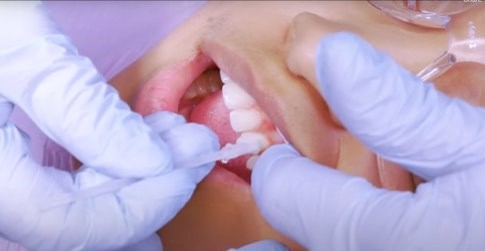
CURODONT REPAIR offers a solution for those patients with early decay which not only will reduce the risk of that lesion progressing, but also does not involve any drilling. This is a shift from passive monitoring to active prevention. (Image provided courtesy of CareQuest.)
How does guided enamel regeneration work – and is it really possible to reverse early lesions with just one application?
Guided enamel regeneration (GER) works through the infiltration of the P11-4 peptide into the lesion body. Once inside, the peptide self-assembles into a biomatrix which attracts calcium and phosphate ions from the saliva. New hydroxyapatite crystals form around the biomatrix leading to regeneration of the enamel and regression of the carious lesion.
Clinical studies have shown that there is a greater than 90% success rate in reducing the size of the initial lesion and reducing the risk of cavitation and caries progression, with effects visible radiographically and clinically over six to 12 months.
They have also found that CURODONT REPAIR showed a significantly superior regression of early caries compared with just fluoride varnish. With over 25 years of research behind it, CURODONT REPAIR definitely shows that we can reverse early lesions with just one application.
We’re used to ‘drill and fill’ in dentistry. What would it take for non-invasive treatments like CURODONT to become the new normal in everyday practice?
To make biomimetic, non-invasive care the new standard, we need a shift in mindset—from restorative to regenerative dentistry. This means early detection, patient education, and tools like CURODONT that empower clinicians to treat disease earlier and more conservatively. Adoption will depend on training, clinical guidelines, and integrating these tools into standard diagnostic workflows.
But the potential is enormous: preserving tooth structure, improving patient experience, and reducing long-term costs. CURODONT REPAIR is not just a product – it’s part of a broader movement toward minimally invasive, biology-first dentistry.
Webinar teaser
In this webinar Dr Victoria Sampson dives into the clinical use of biomimetic regenerative peptide technology, CURODONT REPAIR, as a non-invasive method for treating initial caries lesions, or ‘watch areas’.
It explains the protective role of saliva, and how CURODONT’s self-assembling peptide P11-4 technology penetrates the lesion depth to promote guided enamel regeneration.
Participants will learn when and how to apply this technology, understand its clinical evidence, and gain practical protocols to integrate it into everyday dental care.
Sign up to the on-demand webinar and earn one hour of CPD here.
This article is sponsored by vVARDIS.