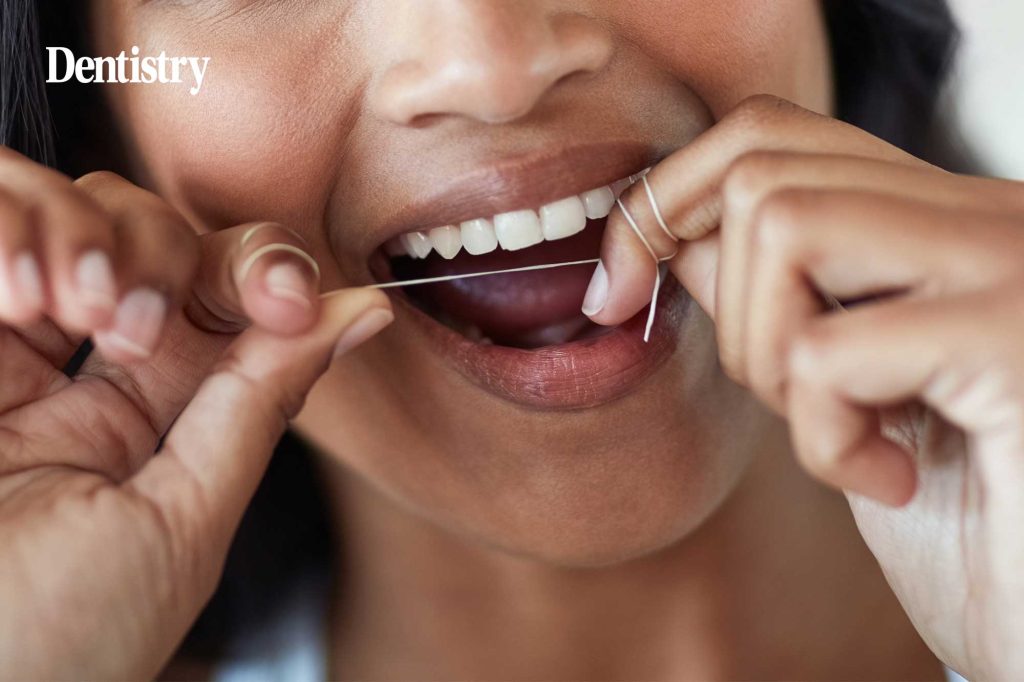
Dental floss can be successfully used to introduce vaccines to the tissue between the teeth and gums.
In a new study, administering a vaccine with dental floss stimulated the production of antibodies in mucosal surfaces, such as the lining of the nose and lungs.
Corresponding author Harvinder Singh Gill said these mucosal surfaces are important because they are an entry point for pathogens such as influenza and COVID-19. However, traditional vaccine injections mainly produce antibodies in the bloodstream instead of the mucosal surfaces.
He added: ‘We know that when a vaccine is given via the mucosal surface, antibodies are stimulated not only in the bloodstream, but also on mucosal surfaces. This improves the body’s ability to prevent infection, because there is an additional line of antibody defence before a pathogen enters the body.’
How do dental floss vaccines work?
To test the delivery method, the researchers applied the vaccine to unwaxed dental floss and then flossed the teeth of lab mice. They compared antibody levels after three types of vaccine: nasal, under the tongue and dental floss.
Rohan Ingrole, the study’s first author, said: ‘We found that applying vaccine via the junctional epithelium produces far superior antibody response on mucosal surfaces than the current gold standard for vaccinating via the oral cavity, which involves placing vaccine under the tongue.
‘The flossing technique also provides comparable protection against flu virus as compared to the vaccine being given via the nasal epithelium.’
Professor Gill said: ‘This is extremely promising, because most vaccine formulations cannot be given via the nasal epithelium – the barrier features in that mucosal surface prevent efficient uptake of the vaccine.’
The layer of tissue between the teeth and gums is well suited to vaccine delivery because it lacks barrier features present in other tissues designed to keep out harmful viruses and dirt.
Consuming food and water immediately after the dental floss vaccine did not affect the immune response.
Could the vaccines be used in humans?
The researchers also considered the practicality of using dental floss as a vaccine delivery method for humans. To avoid holding vaccine-coated floss in the fingers, a floss pick was used instead.
To investigate this further, 27 human participants were given floss picks coated in food dye to transfer to their mouths. Roughly 60% of the dye was successfully deposited in the gum pocket, which shows promise for vaccine delivery.
Professor Gill said: ‘We’re optimistic about that work and – depending on our findings – may then move toward clinical trials.’
While dental floss vaccines would be useful in patients with needle phobia, there are also some drawbacks. For example, they could not be used on infants who have not yet grown teeth. It is also unclear whether the method would work for those with gum disease or other oral infections.
Published in Nature Biomedical Engineering, the full study can be found here.
Follow Dentistry.co.uk on Instagram to keep up with all the latest dental news and trends.