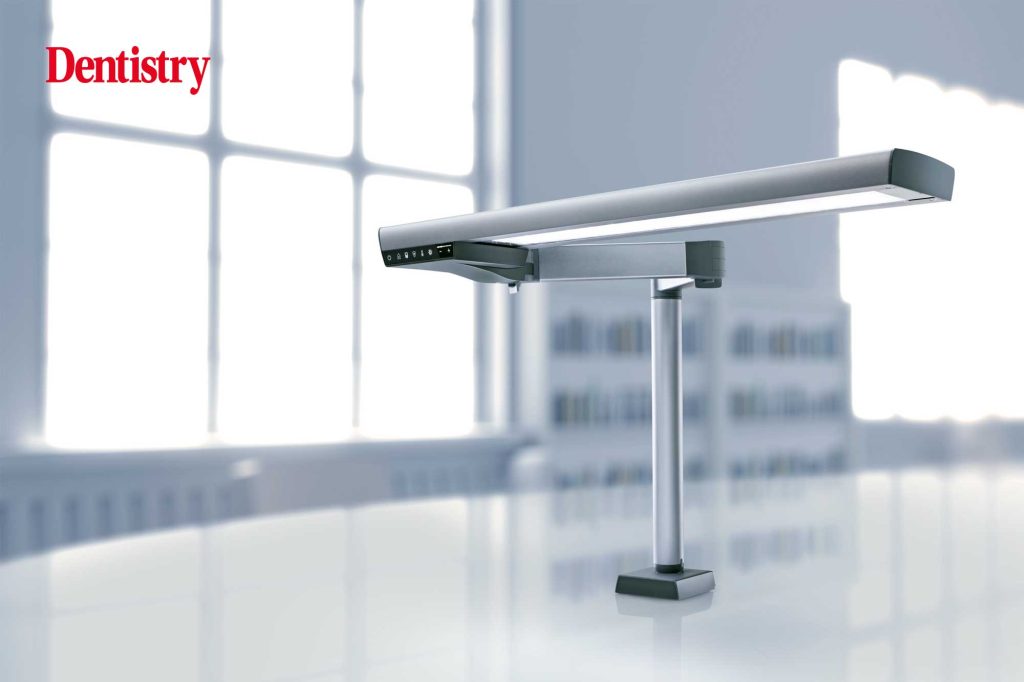
Sascha Hein gets to the bottom of a widespread misconception: neither light nor objects are actually coloured – colour only arises in our brain.
This finding has far-reaching consequences for everyday work in the laboratory, especially for workplace lighting. What does good lighting for dental technology call for?
The science of colour perception
Sascha Hein quotes physicist Isaac Newton as saying: ‘Light is not actually coloured; it only appears that way to us.’ This initially surprising statement makes sense when we understand how colour perception functions: our brain interprets light wavelengths as different colours. However, only a small section of the electromagnetic spectrum is visible to us.
Three elements are usually needed to perceive colour:
- The light source that emits electromagnetic radiation
- The object that reflects or absorbs certain wavelengths, and
- The viewer, whose brain interprets the incoming signals as colour.
The practical significance in dental technology: the number of colours recognisable in the spectrum varies from person to person and may be as many as 100. This individual perception represents a major challenge when determining shades of colour in dentistry.
Did you know?
- The human eye can distinguish up to 100 different spectral colours
- Contrary to popular belief, light itself is not coloured. Colour only comes into being through the interpretation of light waves in our brain
- It has been demonstrated that, with a uniform, high level of brightness throughout the entire working area, dental technicians can demonstrably work in a more relaxed way and faster than with spot lighting
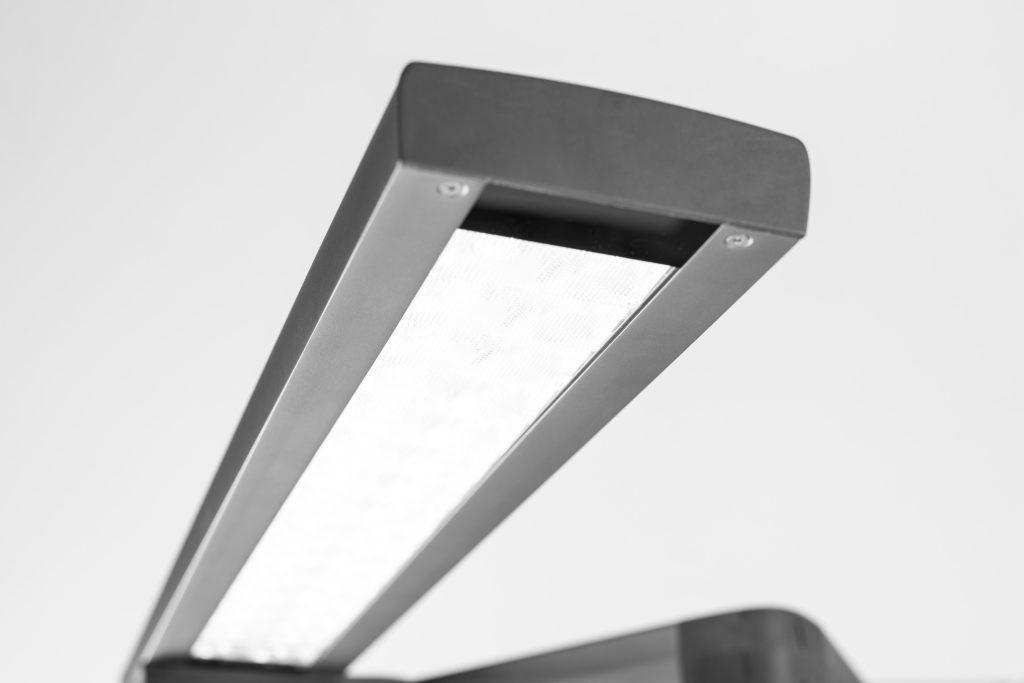
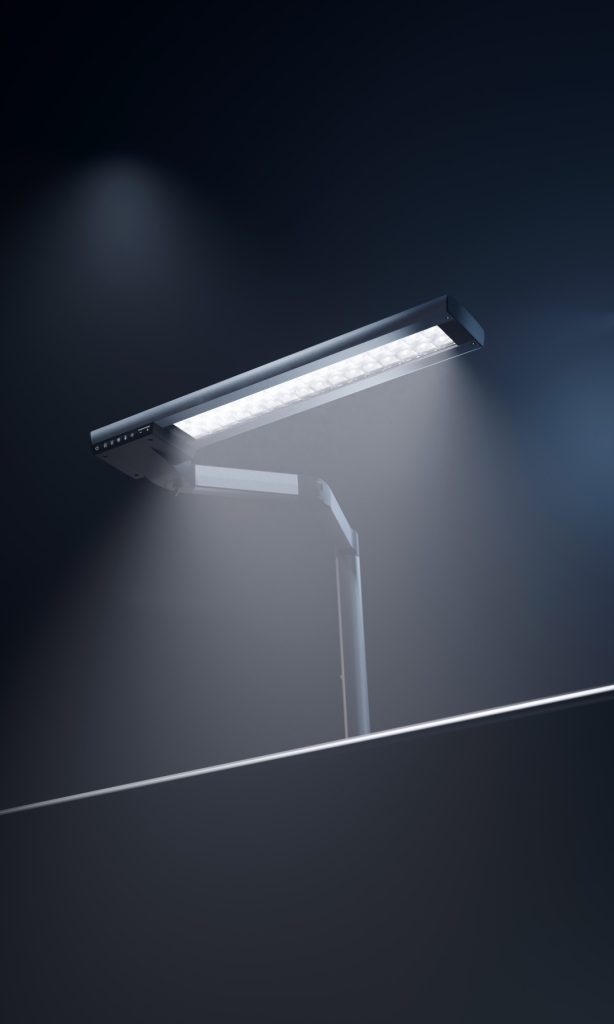
- Conventional lamps illuminate most intensely in the middle and decrease in a circular pattern towards the outside. This limits the illuminance. LIGHT 1, on the other hand, illuminates the entire working area evenly
- The correlated colour temperature of 6500 K corresponds to daylight in the northern hemisphere at midday – the standard for precise colour determination in the laboratory
- A high CRI value alone is not enough to guarantee optimal colour reproduction. Manufacturers may specify the mean value of every test color without specifying the critical minimum value.
The development of lighting technology
The history of artificial lighting shows a steady development:
- Light bulbs: uneven spectrum, low efficiency
- Fluorescent tubes: they have an improved spectrum but contain environmentally dangerous mercury
- Modern LEDs: spectral optimisation is possible.
This technological evolution now enables new solutions, such as Renfert’s LIGHT 1. By combining specially selected types of LED, it achieves
- A colour temperature of 6500 K, corresponding to standard daylight
- A CRI value of Ra 97 (with extended colour matching of 14 colours), which enables particularly true-to-life colour reproduction, and
- A balanced spectrum for precisely assessing tooth colour shades.
Sascha Hein’s practical comparative measurements prove that the spectral energy distribution of LIGHT 1 is particularly close to the standard daylight source. This is vital for correctly perceiving and reproducing tooth colour shades in the laboratory.
The colour rendering index (CRI)
One important criterion for the quality of a light source is the colour rendering index (CRI). It is determined by comparing the colour rendering of a light source with a defined reference source. The standard is the average daylight at noon in the northern hemisphere.
The comparison is made using eight defined test colors, whereby the color temperature of the reference source is adjusted to the light source to be tested. With a colour temperature of 6500 K, the LIGHT 1 comes particularly close to standard daylight and at the same time achieves a very high CRI value of Ra 97 (with an extended colour matching of 14 colours). The balanced spectral energy distribution permits particularly true-to-life colour reproduction.
Scientific findings for practical applications
Understanding colour perception helps us better understand lighting requirements in the laboratory. We can only work precisely and efficiently if all the components – light source, working environment and visual perception – are optimally coordinated.
Making work easy: optimal colour perception in the dental laboratory
The scientific findings described find their practical application in LIGHT 1, the new work light from Renfert.
- Lighting similar to daylight (approximately 6,500 K)
- High colour rendering index (CRI > 95)
- Uniform illumination of the working area
- Regular monitoring of the lighting conditions.
This article is sponsored by Renfert.