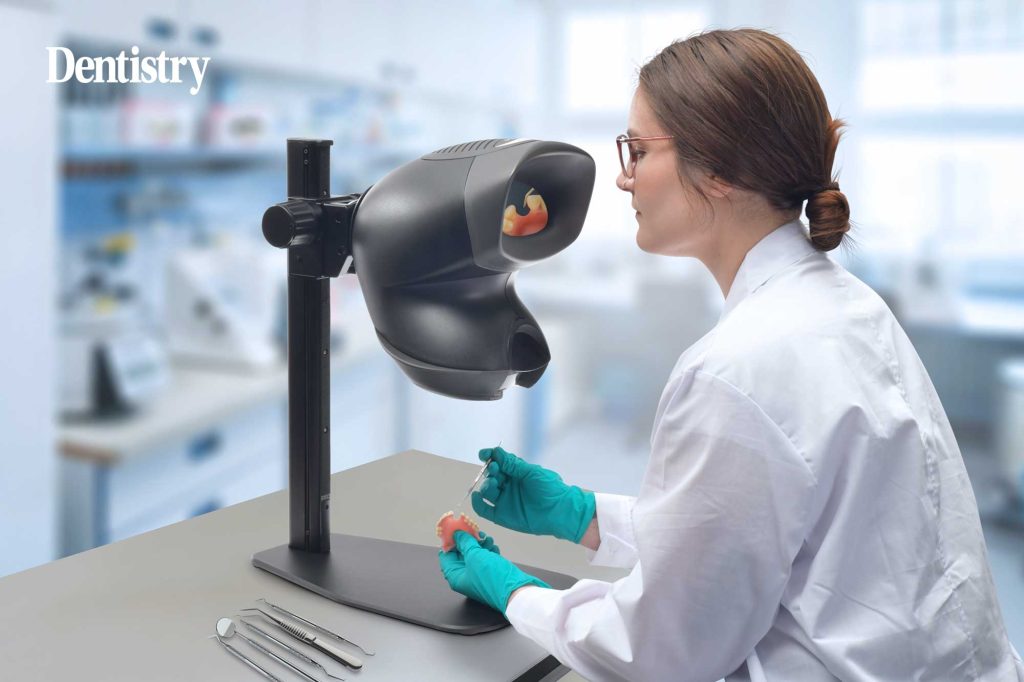
Phillip Townend discusses why it is essential to consider ergonomic factors to microscopy in the dental laboratory.
Dental laboratory technicians perform highly detailed work for long periods, often leaning into microscopes to refine margins, inspect frameworks and layer ceramics. Poor posture, repetitive fine-motor tasks and prolonged static positions create a high risk of musculoskeletal disorders, reduced visual comfort and fatigue that directly affect precision, productivity and career longevity.
Occupational risks for technicians
Musculoskeletal pain in the neck, shoulders, upper back and wrists is common among dental clinicians and technicians who sustain awkward postures and repetitive micro-movements. These conditions increase with cumulative working time and age and lead to reduced productivity, higher error rates, and premature exit from the profession.
Eye strain and visual fatigue also compromise accuracy, especially when technicians move between magnification tools and unaided vision repeatedly during the working day.
How an ergonomic microscope reduces risk
An ergonomically designed microscope enables a neutral, upright posture that offloads strain from the neck and back and reduces shoulder elevation and forward head posture. Improved posture lowers the likelihood of chronic pain and allows technicians to sustain attention and steadiness during fine work, which increases consistency and lowers the rate of remakes.
Ergonomic optics also reduce eye fatigue by providing clearer, high-contrast imagery and a comfortable viewing geometry, allowing technicians to maintain focus for longer periods without visual discomfort.
OPTA stereo microscope
The OPTA stereo microscope from Vision Engineering integrates features specifically aimed at laboratory workflows to deliver ergonomic and productivity gains. Its eyepiece-less, patented optical viewing head produces a 3D stereo image that preserves depth perception while supporting technicians to adopt a comfortable head and neck position, reducing the need to lean forward into traditional eyepieces.
OPTA’s long working distance gives ample space for tools and hands, enabling natural manual techniques and minimising awkward arm extension that increases muscular load.
Its design lowers visual and physical fatigue through crystal-clear optics across practical magnifications commonly used in dental labs, such as 4x, 6x and 8x, allowing technicians to choose the right balance of field of view and detail without compromising posture. The optical system’s high contrast and depth of field help technicians keep multiple restoration layers in sharp focus, which reduces the need for constant refocusing and head repositioning, both contributors to cumulative strain.
The microscope’s ergonomic stand and adjustable head simplify set-up and enable quick user transitions without extensive readjustment, which supports shared workstations and training scenarios while preserving individual comfort. Stable construction and low-vibration performance protect fine motor control during delicate manipulations, translating ergonomic stability into measurable quality improvements and fewer remakes.
Practical lab changes that multiply ergonomic gains
- Adjust seating so hips are slightly higher than knees and use lumbar support to maintain a neutral spine while working with a microscope
- Position the microscope and workpiece so wrists stay neutral and elbows remain close to the body at approximately 90 degrees to reduce shoulder and forearm load
- Use OPTA’s long working distance to keep tools and hands in a comfortable zone, avoiding extended reaches that increase error risk and fatigue
- Rotate tasks and take frequent short micro-breaks to reduce static loading and preserve fine motor steadiness for longer shifts.
Conclusion
Ergonomics is not a luxury for dental laboratory technicians; it is a practical investment in quality, throughput and career health. Microscopes designed with operator physiology in mind unlock sustained precision, reduce the physical toll of microscopic work, and improve visual comfort. The OPTA stereo microscope combines eyepiece-less 3D viewing, long working distance, durable stability, and easy adjustability to deliver tangible ergonomic benefits that raise both technician wellbeing and the standard of dental restorations.
OPTA Stereo Microscope is available to order now. Prices start at £900.
For more information on detailed specifications, pricing or to place an order, contact Dr Tony Lang at dental@visioneng.co.uk or 01483 248300. Alternatively, visit www.visioneng.com/products/opta.
This article is sponsored by Vision Engineering.